
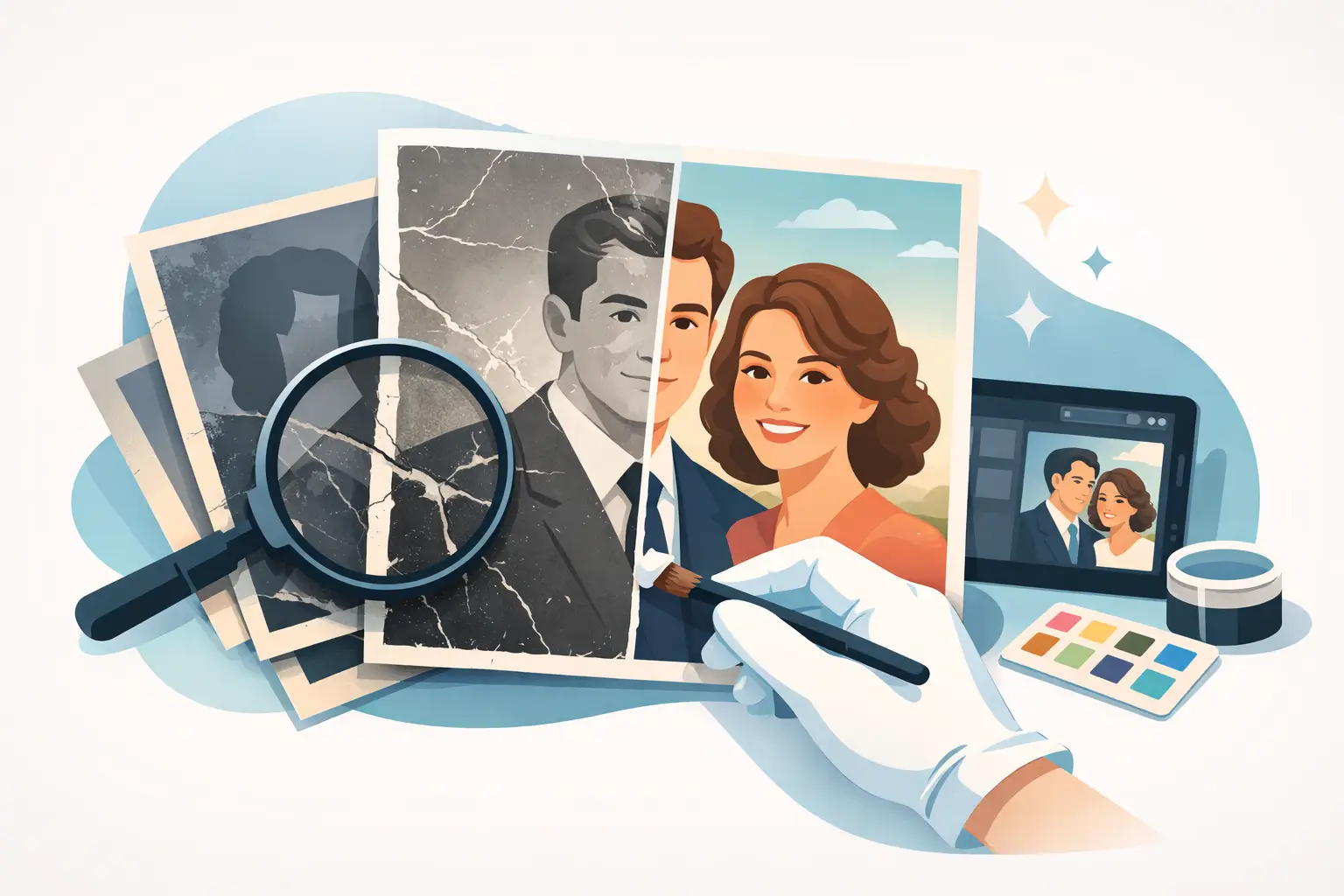
A grandmother’s First Communion photograph, a faded picture of parents on a seaside holiday, a cracked portrait of a grandfather in military uniform — such keepsakes cannot be replaced with a new shot. Retouching old photographs helps hold their history before dust, moisture, light and time take more detail away. Well-done restoration does not change the past. It restores its readability, with respect for the original.
Retouching old photographs starts with a good scan
Even the most careful processing will not repair what was not properly recorded in a digital file. The first stage should therefore be professional scanning of the print. A 600 DPI scan usually works for most family photographs, and 1200 DPI gives more material to work with on small photos, portraits or prints with many fine damages.
High resolution lets you see hair, fabric texture, facial outlines and background details. Those often decide whether the result looks natural. A scan that is too small or of poor quality can make a photograph unnaturally smooth after scratches are removed, and faces lose their character.
A scan is also a form of protection. The original print stays safely in an album or archival box, while the digital copy can be viewed, sent to the family, printed and used for further restoration without risking the only copy.
What kinds of damage can be repaired?
What is possible depends on the condition of the photograph, its size and how much information remains in the image. A retoucher cannot recover a detail that was never there or has completely vanished, but often a great deal can be reconstructed from neighbouring fragments.
Retouching most often includes removing dust, small dirt, stains, creases and scratches. Yellowed paper, uneven colour casts, fading and traces of glue or fingerprints can also be reduced. With cracked prints, separated fragments can be joined and a line of background, clothing or hair reconstructed.
Losses on faces need particular care. If a deep scratch runs through an eye, mouth or cheek, the aim is not to create another person, but to reconstruct features as faithfully as possible from what is visible on both sides of the damage. That needs human judgement, patience and a sense of measure — an automatic filter usually only appears to solve the problem.
A natural result matters more than perfect smoothness
Old photographs have their grain, softness and distinctive modelling. Too strong retouching can remove not only damage but also part of the authenticity: wrinkles, skin texture, the weave of fabric or gentle light transitions. A family portrait after restoration should not look like a contemporary phone photograph.
Good retouching is therefore a selection. What came from damage to the print is removed, and what belonged to the original frame is left. Freckles, a characteristic hairstyle, a shadow on a face or small skin imperfections can have documentary value. They are what let us recognise a close person years later as we remember them.
Agree the expected result before work begins. One person wants only to clean a photograph and keep its aged look. Another plans a large anniversary print and expects more precise reconstruction of cracks and stains. Both approaches are right if they serve the same aim: saving a family memory.
Restoration and colourisation are not the same
Retouching and restoration restore the quality of an existing photograph. Colourisation adds colours to a black-and-white image that were not on the original. It can bring a portrait to life, but it should be treated as an extra interpretation, not a substitute for the historical photograph.
Historically credible colourisation takes into account the period, clothing cut, uniform material, interior colours and natural skin tones. Even then the colour of a dress or the walls in the background cannot always be stated with certainty. If the family has extra knowledge — remembers eye colour, a car or a bouquet — it is worth passing that on before the work.
A good solution is to keep two file versions: a restored black-and-white one and a colourised one. The first stays close to the original; the second can become an exceptional gift, a print or an image for a digital frame.
When does retouching have limits?
Honest restoration does not promise miracles. If a photograph was flooded for a long time, attacked by mould or almost completely faded, some details may be lost for good. The same applies to a large loss covering half a face or the centre of an important element in the frame.
That does not mean it is not worth trying. Sometimes even a partial cleaning lets you recover a look, a silhouette, a name on a sign or the background of a family home. In such cases it is especially valuable to keep an intermediate version that improves readability without inventing elements without enough basis.
A professional assessment before work helps match the scope of the service to the photograph’s real potential. That is more honest than applying one automatic effect to every print, regardless of its history and condition.
How to prepare photographs for safe handover
Do not press a creased print hard, force it flat or try to remove stains with water. Photographic paper, especially older paper, can be brittle, and the emulsion surface is easily damaged further. Hold photographs by the edges with clean, dry hands and lay them singly in rigid interleaves.
If photographs are described on the reverse, keep that information. A date, a place, names or a simple note such as “at Aunt Hania’s” can matter to the family as much as the image itself. With a larger archive it helps to keep prints in album order or number them, without sticking labels directly on the photograph.
At StareZdjęcia materials can be handed over in person or sent by courier, and originals return in an insured parcel. The client receives digital JPG or TIFF files, so memories are no longer locked in a single, increasingly fragile album.
What to do with a restored photograph
The greatest value of retouching is often discovered only after it is finished. One repaired photograph can go into a frame, become a family gift or enter an album prepared for the next generation. A whole archive can be organised in folders by people, places and years, so it is easy to find at family gatherings.
Keep files in at least two independent places, for example on a drive and in a safe backup. Original prints still matter and should be protected from light, moisture and sudden temperature changes. A digital copy does not take their value away — it gives them a chance to survive and lets you share them without constantly taking them out of the album.
You do not have to wait until a photograph disappears completely. Sometimes restoring one portrait is enough to recall a voice, a gesture or a story that no one has written down yet. That can be the start of saving the whole family archive.