
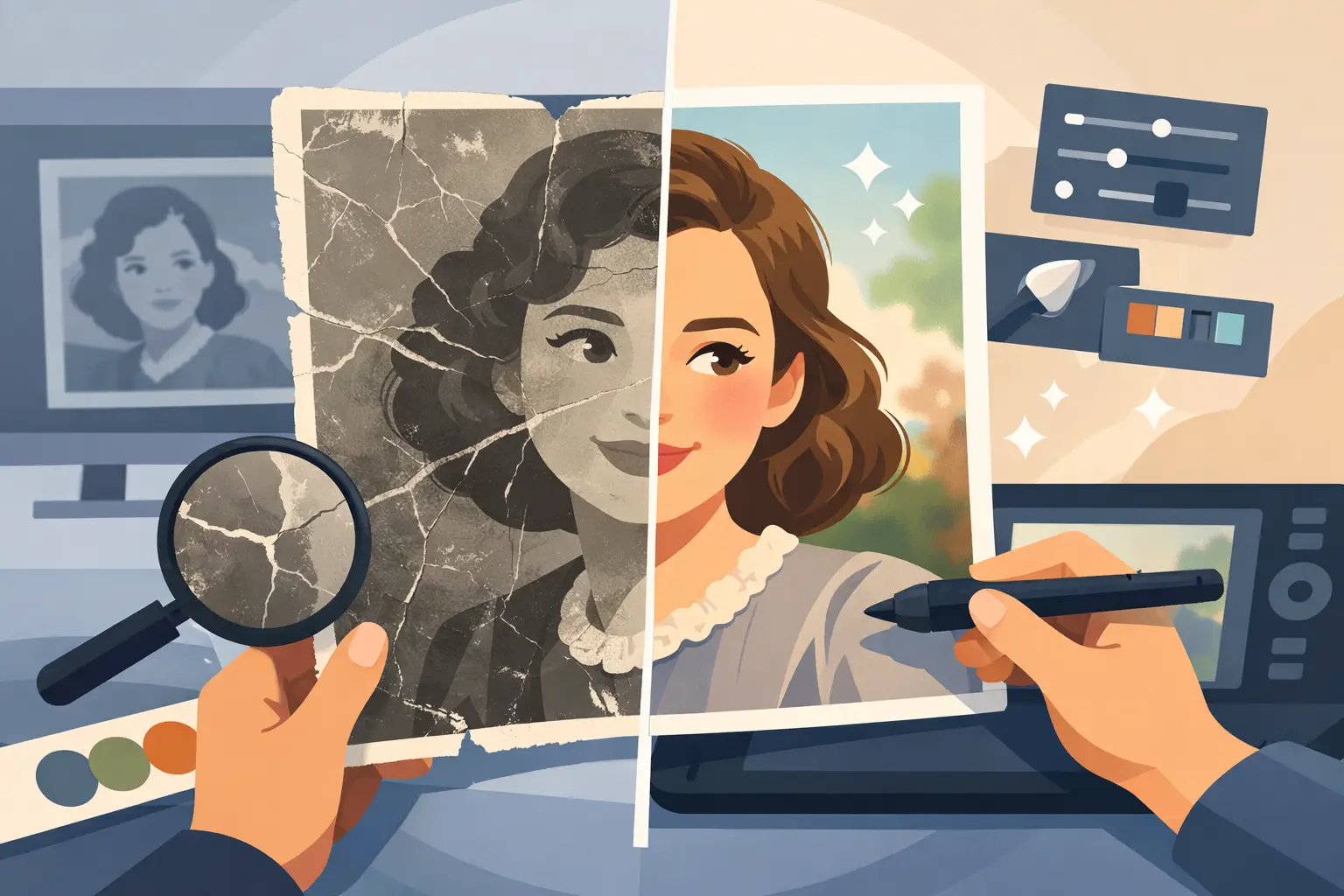
A faded portrait of grandparents, a wedding photograph of parents with a crack through the middle, a childhood picture found at the bottom of a drawer — such prints cannot simply be replaced. Professional photo restoration can save their readability and character before damage becomes permanent. The aim is not a new, perfect picture, but to give the memory as natural a look as possible.
Well-done work means faces, clothing details, background and small things that matter to the family are visible again. It is still the same keepsake — with its period, light and the emotion recorded at the moment the photograph was taken.
What does professional photo restoration involve?
Restoration starts with a safe digital copy of the original. The print is scanned at a suitable resolution, most often 600 or 1200 DPI, depending on its size, condition and planned use. Scan quality matters because it reveals fine scratches, creases, dust or weakened outlines that a phone snapshot might miss.
Only on the digital copy does retouching begin. A specialist removes dirt and traces of time, evens colour casts, rebuilds fragments of background and improves contrast and sharpness where it is justified. The original stays untouched — all work is done on the file. That is especially important when the print is the only surviving copy.
The scope always depends on the type of damage. Small spots and dust can be corrected relatively quickly. A crack running across a face, a missing corner or heavy damp staining needs much more precise reconstruction. Not every piece of information can be recovered if it has physically disappeared from the paper, but experience allows many elements to be restored discreetly and credibly.
Retouching should not change the photograph’s history
The greatest value of a family photograph is its authenticity. Natural retouching is therefore not about smoothing faces like a phone filter, changing features or giving every print the same contemporary colour. Too strong processing can make a portrait stop resembling the person it shows.
Professional restoration keeps the character of the period. The slight softness of an old lens, the grain of analogue material or a distinctive tonality can be part of its charm. In many cases removing the most serious damage and carefully correcting colour is better than trying to “modernise” the photograph completely.
What kinds of damage can be repaired?
Family prints often show similar traces: dust, stains, water marks, scratches, abrasion, fingerprints and yellowed paper. Photographs stored in a cellar, an attic or an old album may also show moisture, mould or having been stuck to another surface.
Digital restoration can usually reduce the visibility of these problems effectively. Crooked scans can be straightened, faded colours corrected, contrast recovered and cracked parts of a print joined. In portraits the face needs particular care — even a small inaccuracy at an eye, mouth or hairline can look unnatural.
The hardest photographs are those with large losses. If part of a figure, a hand or a fragment of a face is missing, reconstruction is based on neighbouring details and knowledge of proportions. The result can be very good, but it is honest to remember that it is not a literal recovery of lost pixels. It is a careful interpretation of the missing fragment, made so that it does not distract from the photograph’s true history.
Restoration and colourisation are not the same
A black-and-white photograph can be restored without adding colour. Removing scratches, improving tonality and bringing out detail is often enough for a portrait to regain strength. Colourisation is a separate service, worth considering when you want a more contemporary reading of a family keepsake or an exceptional gift.
Historically credible colourisation needs restraint. Colours of clothes, skin, interiors and background should match the realities of the photographed period, not a random automatic filter. If the family knows the colour of a dress, a uniform, a car or the walls of a flat, that information helps give the work a more personal and accurate direction.
It is also worth keeping a restored black-and-white version. You can compare both variants, and the archive stays faithful to the original whether or not the colour version is used in a print, a frame or a presentation for relatives.
When is it worth giving photographs to a specialist?
Home apps can help with simple cropping or a slight brightening of a contemporary photograph. With old prints their automatic action often leads to over-sharpening, artificial colour or the removal of important details together with dirt. It is especially risky to “improve” the only photograph by repeatedly photographing it with a phone and stacking filters.
Specialist help makes sense when a print is valuable, damaged or meant to be enlarged and printed. It is also worth using when you plan to digitise a whole album. First you can prepare safe digital files, then choose the most important frames for more advanced restoration.
That is a practical solution for families who want to share an archive. JPG files work for viewing on a phone, sending to relatives and display on a digital frame. TIFF can be a better choice for further archiving or high-quality prints. One well-prepared file lets you make copies for siblings without sending a fragile original on further journeys around the family.
The safety of originals is part of the service
Before handing over photographs many people have understandable worries. An album after grandparents or a single childhood photograph is not an ordinary document — a second copy often does not exist. What matters is not only the retouching result, but the whole process: clear order terms, careful packing, a tracked parcel and a safe return of materials.
Lay photographs flat, without tight rolling and without tape stuck directly to the prints. Separate them with clean paper, secure them against shifting in rigid packaging and add notes about especially important frames. At StareZdjęcia materials can be handed over by courier and, after digitisation and processing, you receive protected files and the insured originals back.
You do not have to restore everything at once. Sometimes the best start is one portrait, a wedding photograph or a picture of several generations together. When you can again see the look of someone close, it is easier to decide to save the whole family archive.